


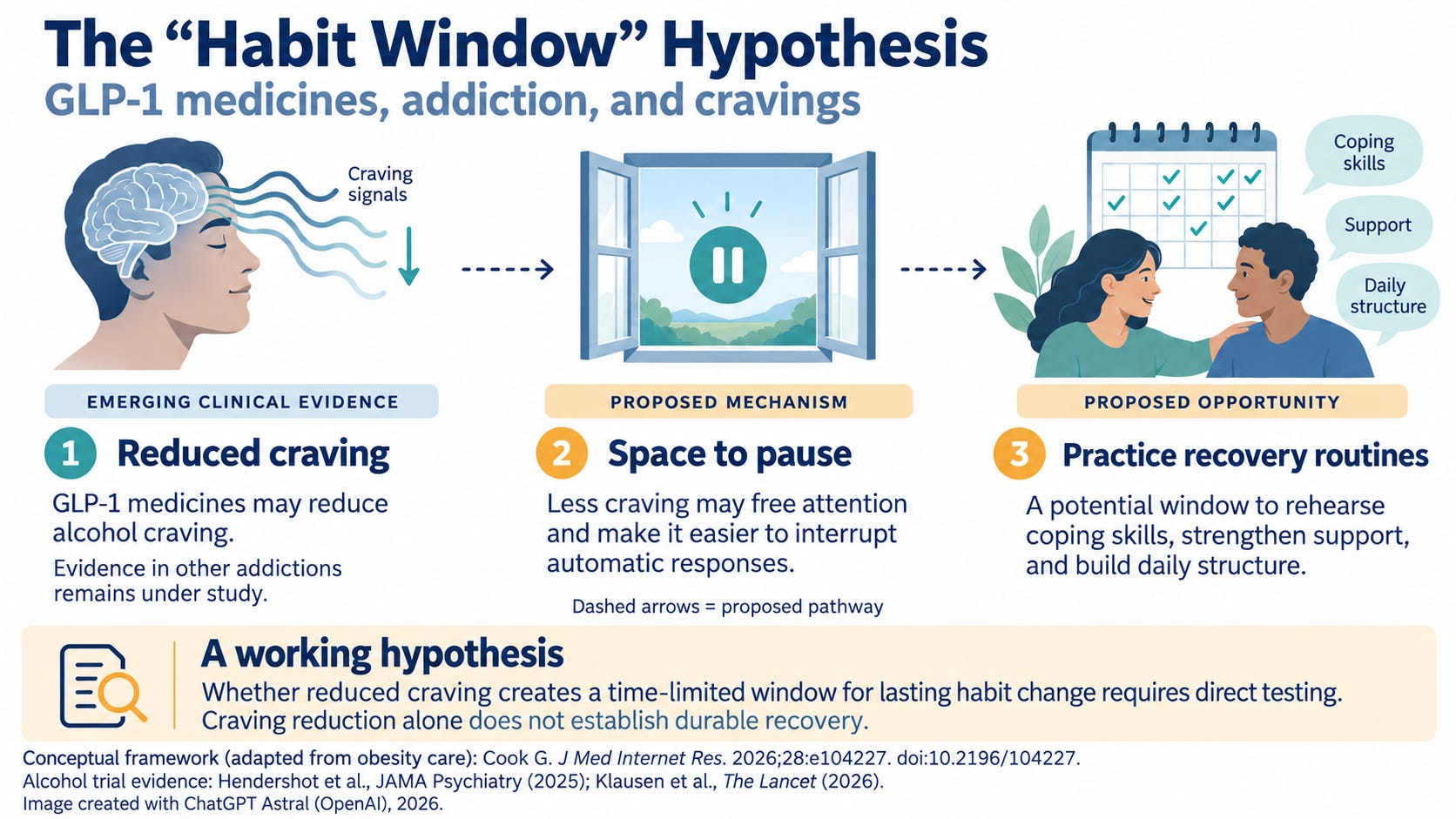
Welcome to our first Quel Health weekly digest, where we’ll dive into what matters in the world of GLP-1s, addiction medicine, and dopamine health.
Today, we’re highlighting the habit window hypothesis, co-occurring OUD and AUD, and a new narrative on the promise of GLP-1s for addiction.
1. Digital behavioral infrastructure for glucagon-like peptide-1 pharmacotherapy: Viewpoint on persistence, tolerability, and postcessation durability, by Geoff Cook
The Summary: While GLP-1 medications have revolutionized weight management, high rates of discontinuation and weight gain after cessation mean that the changes may be impermanent. Noom CEO Geoff Cook presents the term “habit window” to signify a time period in which behavior modification, new habit formation, and lifestyle redesign may be more potent and effective because of decreased food noise. Cook argues that clinical care shouldn’t simply aim to keep patients on medication, but to leverage the habit window to establish new behaviors. Using the frameworks of social cognitive theory and behavioral economics, Cook hypothesizes that digital health programs can maximize the Habit Window by supporting self efficacy, goal setting, and social accountability.
Our Takeaway: We think this is a helpful construct. When consumed with cravings, it is hard to concentrate on anything else, a neurobiological concept called salience. It is when salience is reduced that one can invest that mental equity. However, the extent to which digital health interventions can help maintain habits established during a GLP-1’s “habit window” after stopping the medication is unclear and worth exploring further, especially given that several studies have suggested that lifestyle interventions may not prevent individuals from regaining weight.
That said, we think there may be another type of “habit window” worth exploring. Although the paper frames the habit window’s payoff around what happens after treatment stops, there may be an equally or more important benefit to the window that opens in early treatment, relative to later on. Not only are side effects and weight loss greater at the beginning of treatment, but a recent pre-print of a systematic review exploring GLP-1s and cue reactivity (i.e., how excited your brain gets before a reward) suggests that effects may wane over time as well. If that is the case, there may be an opportunity to establish new habits within the first months of GLP-1 treatment, regardless of whether the medications are continued long-term.
2. Co-treating opioid and alcohol use disorders in the United States, 1960–2026: A historical policy review in the glucagon-like peptide-1 (GLP-1) era, by Fares Qeadan and William A. Barbeau
The Summary: In 2022, eight million Americans had concurrent opioid use disorder and alcohol use disorder. However, our medical system separates these conditions with different regulations, care settings, and prescribing cultures. This policy review by Qeadan (who has authored two retrospective cohort studies on GLP-1s and addiction) and Barbeau chronicles the history of this institutional separation and its impacts on health disparities. The historical synthesis then reviews the extant literature on GLP-1s for opioid use disorder and concurrent opioid and alcohol use disorder, highlighting that if these medications are successful, they will require “coverage, prescriber access, safety monitoring, and integration with MOUD and MAUD.” They caution that financing and delivery systems be proactively aligned to avoid future implementation errors in the next era of GLP-1 prescribing for addiction, so as to prevent the fragmentation and inequities of the past.
Our Takeaway: We appreciate this review, especially its focus on the structural differences in treatments for opioid use disorder and alcohol use disorder, and how these differences translate into harmful downstream biases around race and class. We agree that as the evidence base grows for GLP-1s across multiple SUD diagnoses, the siloed nature of addiction care can create unnecessary and potentially harmful fragmentation. That is, in part, why we are trying to reshape the conversation into one of dopamine health. If these medications treat myriad conditions, it could point to an underlying thread that our classification system is itself incomplete.
3. GLP-1–targeted therapies for alcohol and other substance use disorders: a new era on the horizon?, by Lorenzo Leggio and W. Kyle Simmons
The Summary: This viewpoint by Leggio and Simmons, who are both actively engaged in GLP-1/addiction research at the NIDA/NIAAA Intramural Research Program and Oklahoma State University, respectively, reviews the current evidence for GLP-1s in addiction, their history (highlighting that this topic emerged over a decade ago and that RCTs began before anecdotal reports surfaced) as well as key gaps and opportunities for research. They conclude that, “these studies provide an encouraging outlook toward the potential of incretin-targeted therapies to open a new era in addiction.”
Our Takeaway: This viewpoint is very thorough, and importantly highlights several questions that do not yet have established answers (e.g., “what is the optimal duration of medication?”). One of the gems of this article is that the authors point out that fears around safety for substance use disorders could potentially be eased. They note how, given that GLP-1s are already prescribed at scale and the high prevalence of addiction, many people with addiction may already be prescribed GLP-1s, implying that large safety concerns at scale would already be emerging. They also note that available data from RCTs do not point to significant differences in safety, in comparison to obesity trials. In addition, they highlight how these treatments can help facilitate the treatment of comorbid medical conditions. We appreciate that these leading researchers see these medications potentially heralding a “new era” in addiction care.
Schedule a free call with a provider